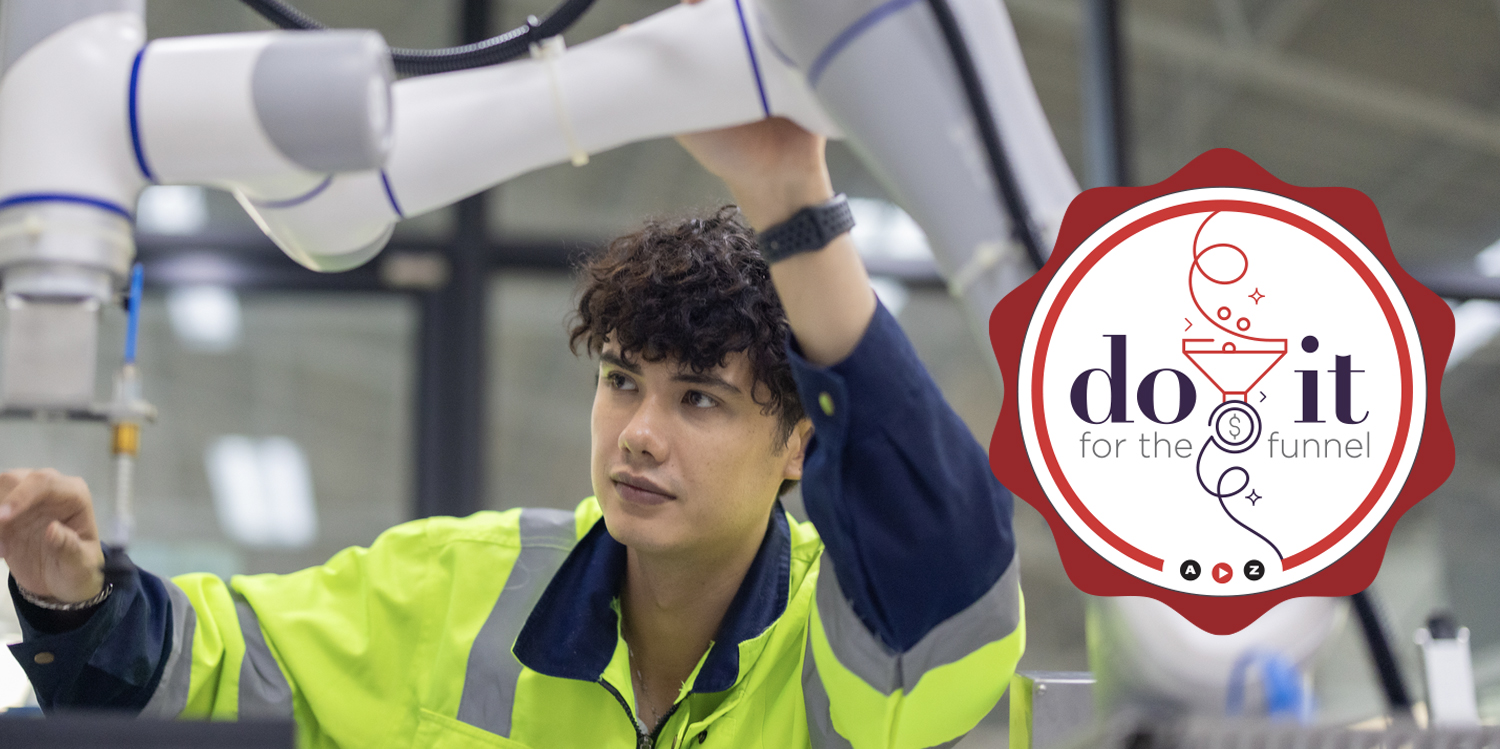


Community colleges have real employer partnerships, real placement data, real stories worth telling—but often it’s hidden behind the same "career-ready, hands-on training" copy everyone runs. So how can colleges take the generic out of their workforce marketing and promote programs in a way that make them actually sound like theirs?
Workforce programs are where community colleges have significant differentiation from other institutions—real employer relationships, real placement pathways, real completion data. So why does that differentiation so often get flattened into generic copy?
Open the workforce development page of almost any community college in the country. Read it carefully. Now open another one. And another.
At some point, the paragraphs start blending together. "Designed to meet employer demand." "Hands-on training in high-growth fields." "Prepare for a career in weeks, not years." The language isn't wrong, necessarily — it's just interchangeable. Swap the school's logo and you could run that copy for the welding program down the road or the CDL program two states over.
Here are some simple practices community college marketers can implement to help your institution’s workforce programming marketing stand out from the crowd.
The Swap Test
Pull up your program page. Read the headline. Now ask: could a competing school drop their logo in and run this same copy?
If the answer is yes, you have a swap test problem. Generic phrases like "career-ready training" and "hands-on learning" are not differentiators. They describe a category, not your program. Audit every workforce program page with the swap test. Flag any headline or body copy that could belong to another institution. This process will help you pinpoint copy to prioritize for revision.
Name Employers on the Program Page
Employers show up in the "partners" section of most college websites. That's not where they belong. Employer-college relationships are most effective when both parties co-develop curriculum and share outcomes data. That relationship is more than a partnership mention. It’s proof the program was built with real employer input.
"Designed with [Employer Name]" hits differently than "industry-aligned curriculum." Identify two or three employer partners per program and work the relationship name into the headline or the first paragraph. This one change can help turn a marketing claim into a credibility signal.
Leverage Skills Gap Data
The skills gap is real data sitting on the table. Most colleges don't use it.
AAC&U's The Agility Imperative (2025) found that employers consistently report gaps in critical thinking, communication, and applied technical skills—field by field, region by region. Cengage Group's 2025 Graduate Employability Report reinforces this, showing that graduates often underestimate the skills employers actually value most.
Those are valuable copy points backed by industry research.
"Employers in [region] report a shortage of qualified [role]" is a better first sentence than anything about career pathways.
Lead with Work-Based Learning Numbers
Apprenticeship completion rates. Clinical placements. Work-based learning is a genuine differentiator. Research indicates that employer partnerships that include structured work-based learning components produce stronger hiring outcomes than credential programs without them. That’s the kind of outcome-backed detail prospective students should see early.
Make Your Employer Partnerships Impossible to Miss
Name the partners, show the work, make the connection impossible to miss. Feature employer logos on program pages. Use quotes from hiring managers, not just alumni. Clearly state, "[Employer Name] has hired [X] graduates from this program" and back it up.
Visibility builds trust on both sides. Prospective students want proof the credential is valued. Employers want recognition that reinforces the relationship.
Getting Down to Specifics
Generic copy usually isn’t the result of weak writing. It’s what happens when the details that make a program distinct never make it into the marketing. Community colleges don’t need more sweeping claims about opportunity or career readiness. They need marketing that reflects the actual structure, partners, and outcomes behind the program.
Every workforce program has a story only it can tell. The job of the marketing isn’t to invent that story—it’s to pull the right details forward so prospective students can see what sets the program apart.
Sources: The Agile Imperative 2025, AAC&U; 2025 Cengage Employability Report, Cengage Group; Employer and Community Partnerships: Models and Practices for Supporting Students and Strengthening Workforce, Cengage Group
Learn more about how A to Z supports higher education teams at edu.atozcommunications.com.
🗒️ Read More Higher Ed Marketing Strategies
✔️ Higher Education Insights
✔️ What's Really Keeping Adult Learners From Hitting 'Apply'
✔️ Competing With Uncertainty—The Real Enrollment Battlefield
Get practical higher ed marketing tips
We help community colleges and universities turn clarity into enrollment performance. Creative that works.